Speed, following distance, lane changes and driving at night
Space is what keeps you out of trouble. Here is how speed sets the gap you need, how to change lanes without taking someone else’s space, and why darkness shrinks your margins.
Several of the hardest car theory questions are really about one thing: how much space you have and how fast you are using it up. Stopping distances, lane discipline and night driving all come back to that.
Speed limits, stopping distances and the two-second gap
For a car, the national limits are 70 mph on motorways and dual carriageways and 60 mph on single carriageways. A road with street lights normally has a 30 mph limit in England and Scotland and 20 mph in Wales unless signs say otherwise. Towing a caravan or trailer brings the limits down to 50 mph on single carriageways and 60 mph on dual carriageways and motorways.
Other vehicles have lower national limits, and the theory test asks about them because you share the road with them:
| Vehicle | Single carriageway | Dual carriageway | Motorway |
|---|---|---|---|
| Car or motorcycle | 60 mph | 70 mph | 70 mph |
| Car towing a caravan or trailer | 50 mph | 60 mph | 60 mph |
| Bus, coach or minibus up to 12 metres long | 50 mph | 60 mph | 70 mph |
| Goods vehicle up to 7.5 tonnes | 50 mph | 60 mph | 70 mph, or 60 mph if articulated or towing |
| Goods vehicle over 7.5 tonnes, England and Wales | 50 mph | 60 mph | 60 mph |
| Goods vehicle over 7.5 tonnes, Scotland | 40 mph | 50 mph | 60 mph |
These are the figures in Highway Code rule 124. A lorry doing 50 mph on a single carriageway is at its limit, not dawdling, which is worth remembering before you overtake one.
A limit is a maximum, not a target. The Highway Code expects you to slow down for bends, schools, parked cars, bad weather and busy pavements even when the sign says 30.
The theory test uses the Highway Code’s typical stopping distances for a car in good conditions:
| Speed | Thinking distance | Braking distance | Overall |
|---|---|---|---|
| 20 mph | 6 m | 6 m | 12 m |
| 30 mph | 9 m | 14 m | 23 m |
| 40 mph | 12 m | 24 m | 36 m |
| 50 mph | 15 m | 38 m | 53 m |
| 60 mph | 18 m | 55 m | 73 m |
| 70 mph | 21 m | 75 m | 96 m |
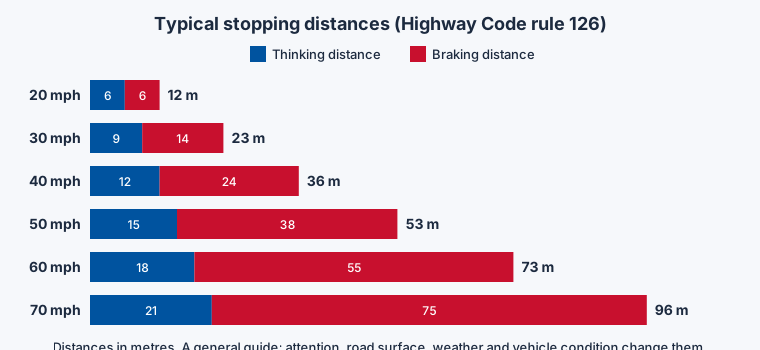
The Highway Code also gives each total in car lengths, taking a car as 4 metres: 3 at 20 mph, 6 at 30, 9 at 40, 13 at 50, 18 at 60 and 24 at 70. A quick check for the thinking distance column is that it is 3 metres for every 10 mph.
Notice that thinking distance rises steadily while braking distance roughly quadruples each time speed doubles. That is why 40 mph instead of 30 mph matters so much outside a school.
On the road you cannot measure metres, so use time. Pick a fixed point such as a lamp post; when the car in front passes it, say “only a fool breaks the two-second rule”. If you reach the point before you finish, drop back. Double the gap in the wet, and allow up to ten times the gap on ice.
The usual wrong answers are “one second is enough on a motorway” and “the same gap applies in rain”. If someone pulls into your gap, ease off and rebuild it rather than closing up.
Changing lanes without forcing anyone to brake
A lane change is safe only if nobody else has to change speed or direction because of it. The sequence is:
- Mirrors: interior, then the door mirror on the side you are moving to.
- Blind spot: a quick sideways glance, because a car or motorcycle can sit just behind your door pillar.
- Signal in good time, then check again.
- Move smoothly, without slowing down in the middle of the manoeuvre.
On a two-lane dual carriageway stay in the left lane and use the right lane for overtaking or turning right. On a motorway keep left unless overtaking; do not move to the left lane to pass someone who is sitting in the middle lane.
In queues, the Highway Code says do not change lanes unnecessarily. Where two lanes become one at low speed, at roadworks for example, merging in turn is recommended; at high speed it is not.
White chevrons bordered by a solid line must not be entered except in an emergency; with a broken border you should enter only when necessary and safe.
When you overtake a cyclist at up to 30 mph, leave at least 1.5 metres, and more at higher speeds. Allow at least 2 metres for horse riders and pedestrians in the road. A typical theory trap shows you overtaking a cyclist just before turning left: the right answer is to stay behind.
Driving after dark
At night you see less, others see you later, and you misjudge speed more easily.
Lights. You must use headlights at night on roads without street lighting, and keep sidelights and rear number plate lights on between sunset and sunrise. Use dipped headlights in built-up areas at night. Dip your main beam for oncoming traffic and when following another vehicle, and keep it dipped while overtaking until you draw level. Fog lights are only for seriously reduced visibility, generally under 100 metres, and must be switched off when it clears.
Being dazzled. If oncoming headlights blind you, slow down and stop if necessary. Looking towards the left kerb, rather than into the lights, helps you keep your position.
Speed. Drive so you can stop well within the distance you can see to be clear. On an unlit country road on dipped beam, that may be far shorter than the speed limit suggests. Pedestrians in dark clothing, cyclists with weak lights and deer on rural roads appear late.
You and your car. Dirty or scratched windscreens scatter light, so clean them inside and out. Do not wear tinted glasses at night. Tiredness is a night risk too: the Highway Code advises against long journeys between midnight and 6 am and recommends a break of at least 15 minutes every two hours.
Night and following-distance questions are often set as pictures, so practise them in the car mock tests and then try the low sun and sudden queue braking examples in the car hazard scenarios. For the signs that set each limit, see UK road signs and parking restrictions.
Read next
More from Car theory test guides
How long a theory test pass lasts
Your theory test pass is valid for two years from the day you pass. Pass the practical test inside that time or you take the theory test again, at …
How the hazard perception test is scored
You score by clicking early on a hazard that has started to develop. Fourteen clips, fifteen hazards, up to five points each, and 44 out of 75 to …
Car theory test format and pass marks
Learn the official DVSA format, the 43 out of 50 and 44 out of 75 pass marks, and how the silent video questions differ from hazard perception.
Junctions and priority rules for learner drivers
Turning and emerging safely, then the priority rules behind give way lines, box junctions, roundabouts and pedestrians crossing a side road.