How the hazard perception test is scored
You score by clicking early on a hazard that has started to develop. Fourteen clips, fifteen hazards, up to five points each, and 44 out of 75 to pass.
The hazard perception test is the second part of the car theory test. You watch 14 video clips and click the mouse when you see a hazard start to develop. There are 15 scored hazards worth up to five points each, and you need 44 out of 75. It follows straight after the multiple-choice questions, with a break of up to three minutes in between if you want one.
The numbers
| Clips | 14 |
| Developing hazards | 15: one in each clip, and two in one clip |
| Points per hazard | 5, 4, 3, 2, 1 or 0 |
| Maximum score | 75 |
| Pass mark | 44 |
| Attempts per clip | One, with no replay |
You are not told which clip holds the second hazard, so keep watching after your first click in every clip.
What “developing” means
A potential hazard is anything that might need a response later. A developing hazard is one that would make you change speed or direction now. DVSA’s example: a car parked at the kerb is doing nothing, so it is not a developing hazard. As you get closer its right indicator starts to flash and it begins to move away. You would have to slow down, so it has become one.
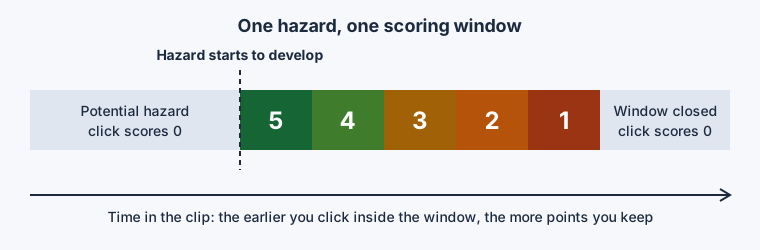
The scoring window opens at the moment that change becomes visible and closes when the hazard has fully played out. Click at the start of the window for five points; the score steps down the later you respond; a click after the window closes, or before it opens, scores nothing for that hazard.
That last point explains the commonest complaint about the test: “I saw it and clicked, and got zero.” Usually the click came a fraction too soon, while the hazard was still only potential. The fix is simple. Click when you first suspect something, then click again a moment later when it clearly starts to happen.
How much clicking is too much
Clicking does not lose points in itself, and a few clicks on things that turn out to be nothing are fine. What scores zero for the whole clip is clicking continuously or in a pattern, for example a steady tap every second. Do that and the clip is lost, however well you spotted the hazard.
As a rough guide, most clips need somewhere between two and six clicks: one or two for each thing that might develop, and a follow-up when it does.
What the hazards usually are
Nearly all scored hazards involve another road user about to enter your path:
- a vehicle emerging from a side road or driveway
- a parked car pulling out, or a door opening
- a pedestrian stepping off the kerb, often from behind a van or bus
- a cyclist moving out round an obstruction
- an oncoming vehicle on your side of a narrow road
- traffic ahead braking sharply
Scan the places they come from: junction mouths, gaps between parked vehicles, bus stops, school entrances and the far side of bends. The ten car hazard scenarios describe the first visible clue in each of these situations.
Hazard perception is not the video question
The multiple-choice part includes three questions about a short, silent video clip that you can replay. That is ordinary multiple choice, scored within the 50 questions. Hazard perception is separate: no questions, no replay, only the timing of your clicks. The car theory test format sets the two side by side.
You need both parts in one sitting
A strong multiple-choice score cannot make up for 43 on hazard perception, and the reverse is also true. Fail either part and you retake the whole test, after a wait of at least three working days.
How to practise
- Try the official practice clips. GOV.UK offers a practice hazard perception test with three free clips, which shows you the real screen and scoring feedback.
- Do commentary driving as a passenger. Say out loud what could happen next: “van at the junction, wheels turning”. You are training yourself to notice the clue before the movement.
- Review, do not just repeat. After a practice clip, name the moment the hazard changed from potential to developing. If you cannot, watch it again for that moment alone.
- Keep your rules sharp too. Timing practice does nothing for the other part, so keep taking free car mock tests alongside.
Read next
More from Car theory test guides
How long a theory test pass lasts
Your theory test pass is valid for two years from the day you pass. Pass the practical test inside that time or you take the theory test again, at …
Car theory test format and pass marks
Learn the official DVSA format, the 43 out of 50 and 44 out of 75 pass marks, and how the silent video questions differ from hazard perception.
Junctions and priority rules for learner drivers
Turning and emerging safely, then the priority rules behind give way lines, box junctions, roundabouts and pedestrians crossing a side road.
Reading UK road signs and parking restrictions
The shape of a sign tells you whether it orders, warns or informs. The same logic explains yellow lines, kerb marks and the places you must never …