Reading UK road signs and parking restrictions
The shape of a sign tells you whether it orders, warns or informs. The same logic explains yellow lines, kerb marks and the places you must never stop.
The car theory test shows a sign and asks what it means, or shows a street and asks whether you may stop there. Both questions are easier once you see that signs and kerbside markings follow a small set of patterns rather than hundreds of separate facts.
How UK road signs are organised
Start with the shape, then the colour, then the symbol.
| Shape | Job | Examples |
|---|---|---|
| Circle | Gives an order | Red ring with 30: maximum speed; blue disc with white arrow: keep left |
| Triangle | Warns | Children crossing, bend ahead, road narrows |
| Rectangle | Informs | Direction signs, lane information, parking details |
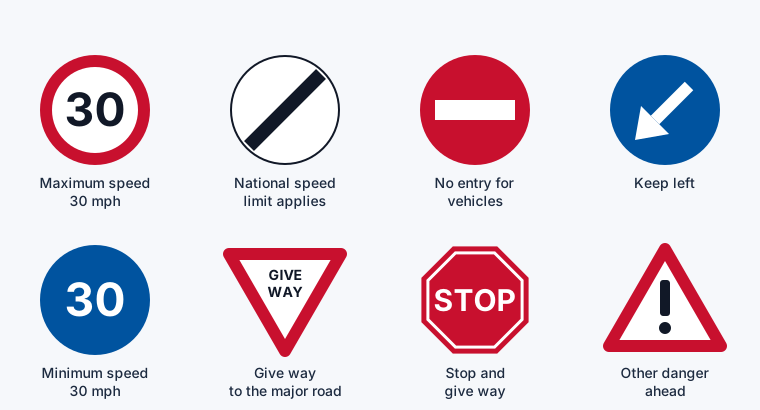
Inside the circles, red usually means “you must not” and blue means “you must”. That is why a red ring with 30 is a maximum limit, while a blue disc with 30 is a minimum speed. A plain white circle with a red ring and no symbol means no vehicles at all.
Two signs break the shape rule on purpose, so you recognise them even when snow or dirt hides the words: the octagonal STOP sign and the upside-down triangle for give way.
Direction signs are colour-coded by road type:
- Blue for motorways
- Green for primary routes
- White with a black border for non-primary and local routes
- Brown for tourist destinations
- Yellow or orange panels for temporary routes and diversions
The national speed limit sign is a white disc with a black diagonal bar. It does not mean “no limit”: for a car it means 60 mph on a single carriageway and 70 mph on a dual carriageway or motorway.
Road markings count as signs too. Along the centre of the road, a broken line with long dashes and short gaps is a hazard warning line, telling you not to cross unless you can see the road is clear well ahead; double white lines with a solid line nearest you must not be crossed except in the situations the Highway Code lists, such as passing a stationary vehicle or overtaking a cyclist, horse or road maintenance vehicle travelling at 10 mph or less.
A classic wrong answer is to read the plate under a sign without the sign itself. “Except for access” under a no-motor-vehicles sign lets you in only if you need to reach a property on that road.
Signs the theory test returns to
| Sign | What it looks like | What candidates confuse it with |
|---|---|---|
| No entry | Red disc with a white horizontal bar | “No vehicles”, which is an empty white disc with a red ring |
| National speed limit | White disc with a black diagonal bar | “End of restriction” in general, or no limit at all |
| Minimum speed | Blue disc with white numbers | A maximum limit, which always has a red ring |
| End of minimum speed | The same blue disc with a red diagonal line through it | A prohibition |
| Clearway | Blue disc with a red ring and a red cross | “No waiting”, which has a single red diagonal |
| Give way | Upside-down triangle with a red border | A warning triangle, which points upwards |
| With-flow bus lane | Blue rectangle showing a bus, with times if it is part-time | A lane you can never enter: outside the times shown, other traffic may use it |
A warning triangle with an exclamation mark means a danger that has no symbol of its own, and the plate underneath says what it is. When a question shows a triangle you do not recognise, the red border already tells you the answer starts with “warning of”.
The test’s sign questions come from the Highway Code and from Know Your Traffic Signs, the Department for Transport’s guide to every sign in use. GOV.UK publishes the full picture set in the Highway Code traffic signs section.
Where you may and may not park
Kerbside rules come in three strengths: places where you must not stop, places where you should not stop, and restrictions that apply only at the times shown on a plate.
Never stop or park here
- On zig-zag lines at a pedestrian crossing
- On a clearway, or a red route with double red lines
- On double yellow lines (unless a plate shows a seasonal exception)
- On the pavement in London or Scotland, outside the limited exceptions
- Facing against the traffic flow at night, unless in a recognised parking space
Avoid stopping here even when it is not marked
- Within 10 metres (32 feet) of a junction, unless in an authorised space
- On a bend, or near the brow of a hill or a hump bridge
- At or near a bus stop, tram stop or taxi rank
- Opposite a traffic island, near a school entrance, or where the kerb is lowered for wheelchair users
Single yellow lines and single red lines restrict waiting only during the times on the nearby plate. Yellow marks on the kerb control loading: one mark means no loading during the times shown, two marks mean no loading at any time.
Leaving the car
Once parked, you must switch off the engine and headlights and apply the handbrake. The Highway Code now recommends opening your door with the hand furthest from it, so a driver uses the left hand on the right-hand door. This turns your body and makes you look over your shoulder for cyclists.
On a hill, turn the steering wheel away from the kerb facing uphill and towards the kerb facing downhill, with a gear selected or “park” in an automatic. On a road with a limit above 30 mph you must show parking lights at night.
Learners lose marks by choosing “park on the pavement to keep the road clear”, or by treating 10 metres from a junction as optional. Read the rules in the waiting and parking section, then see how many sign and parking questions you get right in a free car mock test. Junction markings such as box junctions are covered in the junctions and priority guide.
Read next
More from Car theory test guides
How long a theory test pass lasts
Your theory test pass is valid for two years from the day you pass. Pass the practical test inside that time or you take the theory test again, at …
How the hazard perception test is scored
You score by clicking early on a hazard that has started to develop. Fourteen clips, fifteen hazards, up to five points each, and 44 out of 75 to …
Car theory test format and pass marks
Learn the official DVSA format, the 43 out of 50 and 44 out of 75 pass marks, and how the silent video questions differ from hazard perception.
Junctions and priority rules for learner drivers
Turning and emerging safely, then the priority rules behind give way lines, box junctions, roundabouts and pedestrians crossing a side road.