Motorcycle licence categories A1, A2 and A: ages and routes
AM at 16, A1 at 17, A2 at 19 and a full A licence at 24, or at 21 if you have held A2 for two years. Here is what each category covers and which tests each route needs.
Great Britain has four two-wheeled licence categories, each with a minimum age and a limit on the machine. You can enter at whichever category your age allows (direct access) or step up after two years on the category below (progressive access).
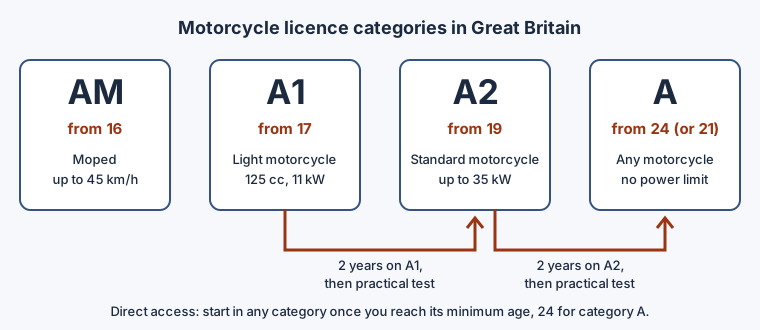
What each category lets you ride
| Category | Minimum age | Machine |
|---|---|---|
| AM | 16 | Moped with a top speed of 25 to 45 km/h (about 28 mph) |
| A1 | 17 | Light motorcycle up to 125 cc and 11 kW, power-to-weight ratio up to 0.1 kW per kg |
| A2 | 19 | Standard motorcycle up to 35 kW, power-to-weight ratio up to 0.2 kW per kg, not derived from a machine of more than twice its power |
| A | 24, or 21 by progressive access | Motorcycle of any size or power, with or without a sidecar |
A CBT certificate alone is not a licence category. It lets a learner with a provisional licence ride a moped from 16, or a machine up to 125 cc and 11 kW from 17, with L plates and no passenger.
Direct access
Direct access means taking the tests for a category as soon as you are old enough for it, without holding the one below.
- At 17: CBT, theory test, then module 1 and module 2 on an A1 machine.
- At 19: the same steps on an A2 machine.
- At 24 or over: the same steps on a category A machine, which gives an unrestricted licence in one go.
While training for A2 or A on a bike bigger than the learner limit, you must be with a qualified instructor who is in radio contact, and you still display L plates.
Progressive access
Progressive access rewards experience. After two years holding a full licence in one category, you can take the practical test for the next one up.
- A1 held for two years: take module 1 and module 2 on an A2 machine, from age 19.
- A2 held for two years: take module 1 and module 2 on a category A machine, from age 21.
This is the only way to hold a full category A licence before 24. You do not take the theory test again for a progressive access upgrade, and you do not repeat CBT.
Which tests each route needs
| Your situation | CBT | Theory test | Practical modules |
|---|---|---|---|
| First motorcycle licence, any category | Yes | Yes | Yes |
| Full car licence, no motorcycle licence | Yes | Yes | Yes |
| A1 for two years, moving to A2 | No | No | Yes |
| A2 for two years, moving to A | No | No | Yes |
| A1 for less than two years, taking A2 or A by direct access | No | Yes | Yes |
The second row surprises car drivers: a car theory pass does not carry over, so you sit the motorcycle theory test even after years of driving.
The bike you bring to the test
The category you get depends on the machine you ride in both practical modules, so the test bike has to meet DVSA’s minimum figures as well as the licence limits.
| Category | Engine | Power | Other |
|---|---|---|---|
| AM | Up to 50 cc | Up to 4 kW | Top speed up to 28 mph |
| A1 | 120 to 125 cc | Up to 11 kW | Capable of 55 mph or more |
| A2 | At least 245 cc | 20 to 35 kW | Power-to-weight up to 0.2 kW per kg |
| A | At least 595 cc | At least 50 kW | At least 175 kg without rider |
Two details catch people out.
- Automatic or semi-automatic. Pass on one and your licence is limited to those transmissions.
- Restricted bikes. A larger machine can be restricted to fit A2, but not to less than half its original power, and you must bring proof of the restriction on headed paper from a dealer, importer or recognised specialist. A dyno printout is not accepted.
Licences from before 19 January 2013
The current categories date from 19 January 2013. If you held a moped or motorcycle licence before then, you keep what you could already ride, though a renewed licence may show it under different letters. Upgrading to a higher category follows today’s rules.
What the theory test asks about this
Category rules appear in the multiple-choice part: what a provisional licence restricts, how long CBT lasts, when a pillion is allowed, what L plates mean under direct access. Several of them are worked through in motorcycle theory test questions explained, and all of them turn up in the free motorcycle mock tests. If you are still deciding what to do first, read CBT or theory test first.
The official table is on GOV.UK under bike categories, ages and licence requirements.
Read next
More from Motorcycle theory test guides
CBT or theory test first? How the two fit together
Compulsory basic training gets a learner onto the road with L plates. The theory test is the first step towards a full licence. You can do them in …
Motorcycle theory test questions explained
The answer on its own is easy to forget. For nine questions that riders search for, here is the correct option, the Highway Code rule or law behind it …
Being seen, riding gear and carrying a pillion
Most rider collisions start with someone who looked but did not see. Learn how to make yourself conspicuous, what protective gear the law requires, …
Motorcycle controls, braking and swerving
A rider uses four limbs for four different jobs. Learn the layout first, then how to share braking between the wheels and when a swerve beats a stop.